
wood floor care
How to Care for Hardwood Floors: Maintenance Tips
How to care for hardwood floors: daily, weekly, monthly, and yearly habits that make polyurethane finishes last 10+ years.
Published
Most hardwood floors do not fail because of the wood. They fail because of how the finish is treated. If you want to know how to care for hardwood floors so they last decades, the answer is almost entirely about protecting the polyurethane layer on top: scratches, grit, UV, moisture, and whatever cleaner you happened to grab at the grocery store. Treat that layer well and a finish can easily last 8 to 12 years before it needs a recoat. Treat it poorly and you can wear through it in 3.
Quick answer: To care for hardwood floors, keep grit off the surface with walk-off mats, dust mop 2-3 times per week, damp clean weekly with a pH-neutral cleaner on a microfiber pad, hold indoor humidity between 35-55%, and recoat at the first signs of dull walkways. Avoid steam mops, vinegar, and shine products entirely.
This is the realistic, no-fluff hardwood maintenance schedule used by professional refinishers, organized from daily habits to once-a-decade decisions.
What is the single most important habit for hardwood floors?
Keep grit off the surface. Sand particles, road salt, and dried mud act like sandpaper under every footstep. The single best thing you can do for polyurethane care is reduce the amount of grit that ever touches the floor.
That means:
- A coarse exterior mat outside every entry door to scrape boots
- A softer interior mat inside the door to catch the rest
- A no-shoes habit, or at minimum no high heels and no cleats
- Felt pads on every chair leg, checked twice a year
Grit control alone will buy you years of finish life. Everything below matters too, but if you only do one thing, do this.
What does a good hardwood maintenance schedule look like?
Daily care is mostly about debris. Weekly care is about the cleaner. Monthly and yearly care catch the things daily habits miss.
| Frequency | Task | Tool |
|---|---|---|
| Daily (high traffic) | Dry sweep entries and kitchen | Microfiber dust mop or soft broom |
| 2-3x per week | Dust mop full floor | Microfiber pad |
| Weekly | Damp clean with pH-neutral cleaner | Microfiber flat mop, lightly misted |
| Weekly | Vacuum rugs and area mats | Vacuum with soft floor head, beater bar OFF |
| Monthly | Move rugs, inspect felts, deep clean | Microfiber + cleaner |
| Yearly | Walk floor in raked light, plan recoat | Flashlight, your eyes |
A few specifics that matter:
- The mop should be damp, not wet. If you can wring water out of it onto the floor, it is too wet.
- Spray the cleaner on the mop pad, not on the floor. Standing liquid is the enemy of any wood floor.
- Skip the steam mop. Heat plus moisture lifts polyurethane and drives water into seams.
- Skip vinegar. It is mildly acidic and over time it can dull the finish.
If you want a cleaner recommendation, look for a “pH neutral” wood floor cleaner from a flooring brand. Bona, Pallmann, Loba, and Rubio all make professional-grade options. Avoid anything labeled “shine,” “polish,” “restore,” or “rejuvenate.” Those add a coating, not just clean.
What should you do once a month?
Once a month, do a closer pass:
- Move area rugs and clean underneath. Trapped grit grinds the finish below the rug edge.
- Inspect chair leg felts. Replace any that are flattened, dirty, or peeling.
- Check entry mats. Wash or replace if they are saturated with dirt.
- Spot-clean any sticky or filmy areas with extra cleaner and a clean microfiber.
- Look at the floor in raked light from a low angle. You will see scratches, dull lanes, and any film building up. Catch problems early.
If you find spots that feel slightly tacky no matter how clean the mop is, that is a sign of cleaner residue or polish buildup. Stop using whatever shine product you have been using and switch to a pH-neutral cleaner only.
How does humidity affect hardwood maintenance?
Wood moves with humidity. Polyurethane does not move with it as easily. The annual cycle of expansion and contraction is normal, but you can keep it within a healthy range.
- Aim for 35-55% indoor relative humidity year-round.
- In dry winter months, run a humidifier. Cracks and gaps are usually a humidity problem, not a wood defect.
- In humid summer months, run AC or a dehumidifier. Cupping is usually too much moisture.
- Once a year, deep clean with a slightly heavier dose of pH-neutral cleaner and a fresh microfiber pad. Move all furniture if possible.
- Once a year, walk the floor with a flashlight at a low angle. Identify the wear lanes. Those will tell you when a recoat is coming.
A recoat (a screen and one or two coats of new polyurethane) is the maintenance event that resets the clock. Done at the right time, you never have to fully sand the floor. Wait too long and the wear goes through the finish into the wood, and now you are looking at a full sand-and-refinish.
How should you handle spills, stains, and pets?
Polyurethane is water-resistant, not waterproof. Wipe spills as soon as you see them. Even a clean spill of water will leave a white haze if it sits long enough to wick into seams.
For pets:
- Trim nails. Long nails put deep micro-scratches in the finish, especially with large dogs.
- Wipe paws after wet walks. Salt and slush carry chemistry that dulls the finish.
- Clean accidents fast. Urine that sits long enough to penetrate the finish stains the wood underneath, and that stain cannot be cleaned, only sanded out.
For sticky messes (syrup, wine, grease), a damp microfiber and your normal cleaner is enough. Do not reach for degreasers, glass cleaner, or all-purpose sprays.
Should you use Murphy’s Oil Soap on hardwood floors?
Short version: do not use traditional Murphy’s Oil Soap on a polyurethane floor. It is a soap, not a pH-neutral cleaner, and the residue it leaves behind builds up over time. That residue is what blocks recoat adhesion years later. We see it constantly on floors built between 1990 and 2015 where the homeowner used Murphy’s weekly out of habit.
If your floor is unfinished, oiled, or waxed, Murphy’s has a more legitimate use case. On polyurethane, choose a pH-neutral wood cleaner instead.
When does maintenance turn into a recoat?
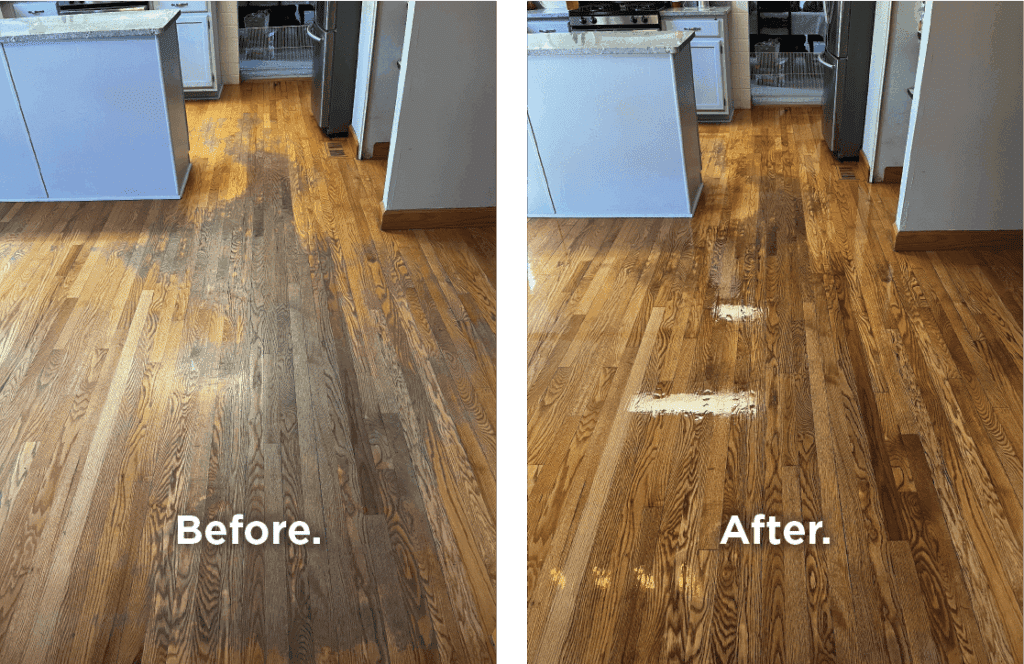
You can squeeze a lot of life out of a finish with good habits. You cannot squeeze infinite life. The recoat window is when the finish is worn but the wood underneath has not been touched. Signs you are in that window:
- Visible dull lanes in walkways
- Light scratches that catch raking light but do not show bare wood
- Cleaning no longer brings back any luster
- Edges around rugs look noticeably brighter than the open floor
Hit that window and a recoat is a fast, low-disruption job. Miss it and you are looking at a full refinish, which is more expensive, more disruptive, and more invasive.
The maintenance philosophy in one paragraph
Keep grit off the floor. Use a damp microfiber and a pH-neutral cleaner. Skip anything that promises shine. Control your humidity. Wipe spills fast. Recoat at the first sign of dull walkways instead of waiting for bare wood. Floors that are cared for this way look almost new for a decade and stay sandable for generations.